
Live medical stock: 2026 guide to informed procurement
October 1, 2026 · 15 min read
What if a supplier listing shows availability when you check, but changes before your order is confirmed? That is the central procurement risk behind live inventory medical supplies. Current supplier information can help teams identify potential sources, but it isn’t a delivery guarantee. Availability, quantity and fulfilment details still need confirmation before you proceed.
Procurement teams know that timing matters. Supplier listings and internal stock records serve different purposes: one supports sourcing decisions, while the other tracks what your organisation has on hand. Treating them as interchangeable can leave gaps in replenishment planning.
This 2026 guide explains what live supplier inventory means in B2B healthcare, which listing details to check before requesting or comparing quotes, and how to monitor an order once it progresses. It also outlines how MEDZA 360 connects inventory discovery with quotation comparison, supplier profiles, document review and order tracking, without replacing internal stock control. Use these steps to organise discovery, confirmation and follow-up, and to distinguish what is known from what still needs checking.
Key Takeaways
- Use live inventory medical supplies listings to identify sourcing options, then obtain supplier confirmation before making a procurement decision.
- Follow a clear sequence: define the requirement, review listings, confirm availability details, request terms and monitor the order.
- Check listing recency, product identity and quantity context, and assign an owner to resolve unanswered questions.
- Use MEDZA 360 to connect product discovery with quote comparison, document review and order tracking, while retaining internal stock control processes.
What live inventory for medical supplies means in B2B procurement
In institutional healthcare procurement, live supplier inventory is availability information published by a manufacturer or distributor to help buyers identify potential sources for products such as medical devices, diagnostics and consumables. The phrase live inventory medical supplies describes supplier-side visibility, not a confirmed allocation or delivery commitment. Listings can vary in age and detail, so confirm the information with the supplier before acting.
Supplier inventory visibility shows what a supplier reports as available; it doesn’t confirm that stock is reserved, suitable for the requirement or ready for delivery. Listings inform the next procurement step. Supplier confirmation and agreed order terms establish what can proceed.
Supplier availability versus internal medical stock
A supplier listing may show that a medical consumable is available to enquire about. Separately, a clinic’s storeroom record might show that its remaining packs are low. The listing helps the procurement team investigate replenishment; the internal record informs the clinic’s view of its own stock position.
These records have different owners and purposes. Suppliers publish availability for sourcing. The healthcare organisation counts and controls its on-hand stock, including how it is recorded and when replenishment is needed. A supplier listing can’t replace that internal process, just as an internal stock balance can’t confirm what a supplier can fulfil.
Why availability visibility matters to healthcare buyers
Earlier visibility of potential supply options gives buyers a basis for prioritising enquiries, particularly when a requirement is time-sensitive. Instead of relying only on an old email or catalogue entry, a team can review supplier information, identify a possible source and ask relevant questions sooner.
This is one input to supply chain management, where information helps coordinate sourcing and decisions across the supply process. Its value depends on how it is interpreted: a listing can guide an enquiry, but it can’t establish whether the required quantity, delivery timing or other terms will be met.
For procurement teams, the practical distinction is straightforward. Use supplier visibility to find and assess options, internal stock control to understand facility needs, and supplier confirmation to check availability and fulfilment terms before progressing an order. This supports informed decisions without treating a listing as a guarantee or assuming it will prevent a stockout.
How live medical supply inventory moves from listing to procurement decision
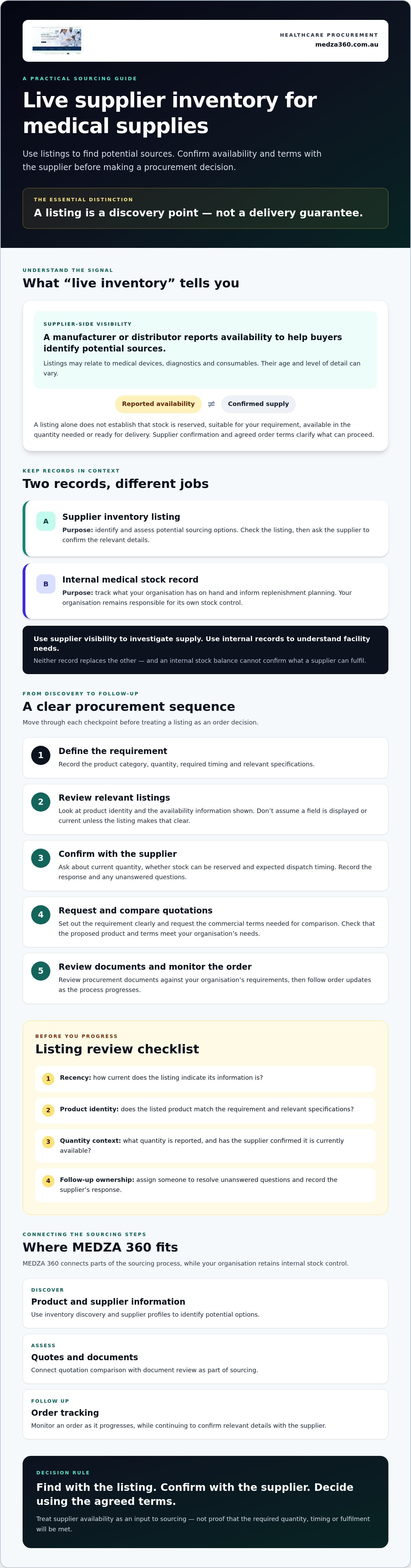
A supplier listing is a discovery point, not the end of the procurement process. To use live inventory medical supplies information responsibly, move from a defined requirement to supplier confirmation, then assess terms and monitor any resulting order. This sequence keeps availability data in context and gives each decision a clear checkpoint.
A visible listing indicates reported availability; confirmed, orderable supply requires direct supplier confirmation and agreed order terms. A listing may not establish whether the required quantity is still available, can be reserved or can meet the required timing.
From a product requirement to supplier confirmation
Begin by recording the product category, quantity, required timing and relevant specifications. This gives your team a consistent basis for assessing listings and supplier responses. Then check available listings for product identity and any availability information shown. Don’t assume a field is displayed or current unless the listing makes that clear.
Before progressing, ask the supplier to confirm the details that affect the decision. These may include current quantity, whether stock can be reserved and expected dispatch timing. Record the response, note unanswered questions and assign someone to resolve them. This creates a practical hand-off from discovery to confirmation instead of treating an online status as a purchase commitment.
Where quotations, documents and order updates fit
Once a listing appears relevant and availability has been checked, submit a structured quotation request. Specify the requirement clearly and ask for the commercial terms needed to compare responses. Quote comparison supports the sourcing decision, but doesn’t replace checking whether the proposed product and terms meet your organisation’s needs.
Review documents exchanged during procurement against your organisation’s own requirements. Their availability supports review, but doesn’t establish regulatory or import compliance. Planning, sourcing and inventory management are essential supply chain processes, but each requires its own checks and decisions.
Order tracking comes later, after an order has progressed. It helps the buyer monitor order status; it doesn’t prove that the listing represented available, reserved stock at an earlier point. MEDZA 360 connects listings with quotation requests, document exchange and order tracking in a B2B sourcing workflow. Buyers can review MEDZA 360’s healthcare sourcing platform as one way to organise those stages.
Live supplier inventory versus medical inventory software
Supplier listings and internal inventory systems provide different kinds of information. Internal records help an organisation understand what it holds and uses. Supplier listings help procurement teams identify external sources to investigate. Neither is a substitute for the other.
| Comparison point | Internal inventory software | B2B sourcing platform |
|---|---|---|
| Data owner | The healthcare organisation | Suppliers publish product and availability information |
| Primary user | Facility, stores and procurement teams | Buyers and suppliers involved in sourcing |
| Purpose | Record and manage facility-held stock | Support supplier discovery and procurement activity |
| Typical workflow | Record receipts and usage, review balances, plan replenishment | Review listings, request and compare quotes, exchange documents, track orders |
What internal inventory systems are designed to manage
Internal systems help an organisation account for supplies held by a facility. Depending on the software and the organisation’s processes, they may support recording deliveries, tracking usage, monitoring stock balances or managing replenishment. Features vary, so assess each system against operational requirements rather than assuming every tool offers the same functions.
Accuracy depends on consistent processes. If receipts, transfers or usage aren’t recorded correctly, the system may not reflect what is physically available. The organisation remains responsible for maintaining its internal records and deciding who updates them.
What a B2B sourcing platform is designed to support
A sourcing platform addresses the external side of procurement. It can help buyers discover suppliers and review listed product and inventory information, then progress to quotation requests, document exchange and order tracking. MEDZA 360 supports these sourcing activities; it isn’t standalone software for controlling a facility’s on-hand stock.
Document exchange supports procurement review, but doesn’t certify that a product meets an organisation’s requirements or guarantee regulatory or import compliance. A supplier listing doesn’t guarantee fulfilment either. These distinctions matter alongside strategic healthcare procurement trends, where teams must consider visibility as one input among broader sourcing and inventory decisions.
An organisation may need internal inventory software to manage facility-held stock, sourcing access to find and assess external supply, or both when replenishment depends on connecting internal requirements with supplier options. Treat live inventory medical supplies listings as procurement inputs, while keeping stock records, supplier confirmation and order monitoring as distinct responsibilities.
How to assess live inventory listings before sourcing medical supplies
A listing is useful only if your team can establish what it describes and whether the information is actionable. Assess live inventory medical supplies listings against the procurement requirement, then confirm material details with the supplier. Keep this check separate from broader supplier, product and document due diligence.
Questions to resolve before relying on listed availability
Use a consistent checklist. Record the listing information, the supplier’s response and any unresolved points before progressing a request.
- Recency: Check the date or time the inventory information was last updated, if a timestamp is shown. If it isn’t, ask the supplier when availability was last confirmed.
- Product identity: Match the product name and any displayed identifier against the organisation’s requirement. Confirm relevant specifications directly if the listing doesn’t provide enough detail to establish a match.
- Quantity context: Clarify whether a stated quantity is available, allocated, indicative or subject to confirmation. Don’t assume it represents stock that can be reserved for your order.
- Supplier confirmation: Confirm the quantity currently available, whether it can be allocated or reserved, and the expected dispatch arrangements. Record the response and when it was received.
Not every listing will display the same fields. Treat missing information as a question to resolve, not as confirmation that a requirement has been met. Before progressing, document unanswered questions, who owns each follow-up and who has authority to approve the next step.
Governance checks for regulated healthcare products
Availability is only one part of procurement review. Identify which supplier, product and transaction documents your organisation needs to assess, and follow its own approval process. For relevant products, check applicable Therapeutic Goods Administration (TGA) and Australian Register of Therapeutic Goods (ARTG) information through appropriate official sources. Requirements depend on the product and context, so don’t infer compliance from a listing or document exchange alone.
MEDZA 360 supports document exchange for procurement review; this doesn’t guarantee regulatory or import compliance. The buyer remains responsible for assessing documents against its requirements and resolving gaps before proceeding.
Close the review with a clear record of what was verified, what remains outstanding, who owns each follow-up and what decision is authorised. This makes the basis for progressing, pausing or declining a sourcing request easier to trace.
To organise supplier discovery, quotation requests, document review and order monitoring in one sourcing workflow, review MEDZA 360 sourcing workflows.
Using MEDZA 360 to connect live inventory with healthcare sourcing
MEDZA 360 is an Australia-based B2B healthcare sourcing platform connecting procurement teams with manufacturers and distributors. It supports sourcing, not the management of a facility’s internal stock. Buyers can review supplier product and inventory listings, then progress through quotation requests, document exchange and order tracking. Each stage provides different information, and none removes the need for buyer checks or supplier confirmation.
For healthcare procurement teams
Use a listing as an initial sourcing signal. Check whether the product information appears relevant to the requirement, then confirm availability, quantity and timing with the supplier before progressing. The listing can help identify a potential source, but it doesn’t reserve stock or guarantee fulfilment.
Once a suitable option is identified, request and compare quotations to assess supplier responses and terms. Review exchanged documents against your organisation’s requirements, then use order tracking to monitor an order that has progressed. These are distinct steps: a quotation isn’t an availability confirmation, document exchange doesn’t guarantee regulatory or import compliance, and order tracking doesn’t establish what was available when the original listing was viewed.
Apply your organisation’s procurement, product and compliance procedures throughout. Keep internal stock records within your own stock-control process, and retain a clear record of supplier confirmations and decisions.
For manufacturers and distributors
Supplier profiles and product inventory listings provide a way to present sourcing information to healthcare buyers. Keep product details and availability information accurate and current. When a buyer needs clarification, a prompt, specific response can help them assess whether the listed option meets their requirement.
Listings are sourcing information, not a promise of a particular sales outcome or a substitute for confirming order details. Don’t assume an update interval or quantity unless the supplier has provided and confirmed it.
For buyers, the practical value of live inventory medical supplies is a clearer starting point for supplier discovery, followed by checks, quotation review and order monitoring. For suppliers, accurate listings and profiles support the sharing of relevant sourcing information. The platform connects these activities without replacing internal stock control or either party’s responsibilities.
Explore MEDZA 360 to review how its listings, quotation comparison, document exchange and order tracking can support a structured healthcare sourcing workflow.
Make supplier visibility part of a controlled procurement process
Live inventory medical supplies listings can help Australian healthcare procurement teams identify potential sources, but they are a starting point, not a guarantee of fulfilment. Confirm product identity, quantity and timing with the supplier before progressing. Keep these checks separate from internal stock control, which remains the organisation’s responsibility.
A disciplined process moves from discovery to supplier confirmation, quotation review, document assessment and order monitoring. Each stage answers a different question. Supplier profiles and document exchange can support procurement review, while the buyer remains responsible for applying its own product, supplier and compliance requirements.
MEDZA 360 brings these sourcing steps together through live inventory listings, quotation requests and comparison, document exchange and order tracking. It supports procurement activity without replacing internal inventory systems or guaranteeing stock, delivery or compliance outcomes.
To see how these functions may fit your sourcing process, explore MEDZA 360’s healthcare sourcing platform. Clear checks and defined decision points can help your team make more informed procurement decisions.
Frequently Asked Questions
What does live inventory mean for medical supplies?
Live inventory for medical supplies means availability information provided by suppliers to help buyers identify potential sourcing options. It differs from an organisation’s internal stock record, which tracks supplies the organisation holds or manages. Treat a listing as a procurement signal, not confirmation that the required quantity remains available or can be delivered. Before deciding, confirm the product details, current availability and relevant terms directly with the supplier.
How can healthcare buyers check whether a medical supply listing is current?
Check for a visible update date or other information showing when the listing was reviewed, if provided. Match the product identifier and specifications to your requirement, then clarify what any listed quantity means and whether it is available or subject to allocation. If key details are missing, ask the supplier before relying on the listing. Record the response and follow your organisation’s procurement process before placing an order.
Is live supplier inventory the same as medical inventory management software?
No. Supplier inventory visibility helps buyers identify products and availability information offered by suppliers. Medical inventory management software generally supports an organisation’s records for stock it holds, receives or distributes internally. Procurement teams may need both sourcing access and internal stock controls, depending on their workflows. Neither automatically replaces the other. Select systems according to the information your organisation needs to maintain and the decisions each system must support.
Can live inventory guarantee that medical supplies will be delivered?
No. A listing can help identify potential supply, but availability may change and delivery depends on supplier confirmation and agreed transaction terms. Confirm the product specifications, quantity, dispatch expectations and any relevant conditions before proceeding. Order tracking can help monitor an order after it progresses, but it doesn’t prove that stock was reserved or guaranteed when the listing was first viewed. Treat each stage as a separate confirmation point.
What should procurement teams verify before ordering pharmaceuticals or medical devices?
Confirm that the product matches the required specifications and that supplier, product and transaction records meet your organisation’s review requirements. For regulated products, check applicable Australian requirements and relevant Therapeutic Goods Administration (TGA) or Australian Register of Therapeutic Goods (ARTG) information through appropriate official sources. Requirements can vary by product and transaction. A platform’s document exchange or supplier verification supports review, but shouldn’t be treated as a compliance guarantee.
Does MEDZA 360 manage a hospital’s internal medical stock?
No. MEDZA 360 is a B2B healthcare sourcing platform connecting suppliers and procurement teams. Its stated functions include live inventory listings, quotation requests and comparison, document exchange and order tracking. It isn’t standalone software for managing a facility’s storeroom, usage records or replenishment controls. Healthcare organisations should maintain internal stock processes and use systems suited to their inventory requirements, separately from supplier discovery and sourcing workflows.
Can Australian healthcare organisations use a sourcing platform for overseas suppliers?
Yes. MEDZA 360 supports cross-border sourcing, which can help healthcare organisations consider suppliers beyond Australia. Each potential transaction still requires assessment of product suitability, supplier and transaction documentation, terms and applicable import or regulatory requirements. Confirm relevant details with qualified internal teams and appropriate official sources. Platform access or document exchange doesn’t guarantee that a supplier, product or transaction meets every compliance obligation.