Medical Device Sourcing Platform: A Buyer’s Guide for 2026
October 3, 2026 · 15 min read
What if a medical device sourcing platform helped make procurement more controlled by bringing supplier and product information into one workflow? For Australian healthcare procurement teams, fragmented channels can make it difficult to check inventory details and compare supplier responses consistently.
A platform can organise product listings, quote requests and comparisons, document exchange and order tracking. It can improve visibility across sourcing tasks, but it can’t replace your organisation’s supplier qualification, regulatory checks or purchasing controls. Those responsibilities remain with your team.
This guide explains which tasks a medical device sourcing platform can support and how to assess whether it fits your procurement requirements. You’ll find a practical framework for reviewing supplier profiles, product and inventory information, documents, quote responses and workflow fit. It also covers how to identify next steps while maintaining internal governance and due diligence, including when sourcing across borders.
Key Takeaways
- Map your existing sourcing process, approval owners and systems before assessing platform fit.
- Use a medical device sourcing platform to organise supplier discovery, quote comparison and order visibility, while retaining buyer-side due diligence.
- Compare platforms against catalogue relevance, stock information, document handling, user permissions and record-keeping requirements.
- At each procurement stage, record key requirements, quantities, delivery needs and evidence reviewed.
- Set baseline measures for request handling, response completeness and order-status visibility to assess whether a platform supports your workflow.
What a Medical Device Sourcing Platform Does for Institutional Buyers
A medical device sourcing platform is B2B infrastructure that connects product discovery, supplier information and procurement activity. It gives institutional buyers a place to review listings, identify potential suppliers, submit quote requests and follow order progress. Its role is to organise sourcing information, not to make purchasing decisions on the buyer’s behalf.
This distinguishes it from adjacent systems. Sales-enablement tools support supplier sales teams and customer engagement; ERP systems manage broader finance, inventory and operational records; public product catalogues primarily present product information. A sourcing platform focuses on the path from finding a relevant product and supplier to progressing an enquiry and tracking an order. It forms one part of supply chain management, where coordinated information helps teams manage the movement of goods and related activity.
For Australian healthcare procurement teams, the practical value is improved discoverability, more structured enquiries and a clearer view of the order journey. A listing is an input for assessment, not proof that a device is suitable for a particular use, meets required quality expectations or complies with applicable regulatory requirements. Buyers must assess supplier and product evidence through their own governance processes.
Which medical device sourcing tasks can a platform support?
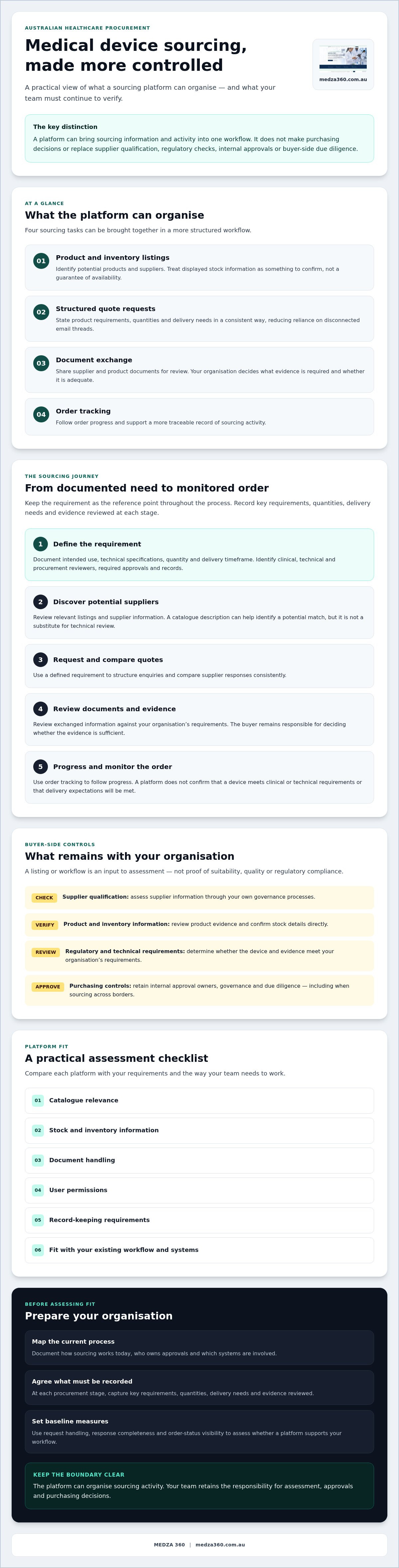
Platforms can bring several sourcing steps into a consistent workflow:
- Product and inventory listings: Help buyers identify potential products and suppliers. Treat displayed stock information as an indication to confirm, not a guarantee of availability.
- Structured quote requests: Give buyers a consistent way to state product requirements, quantities and delivery needs, reducing reliance on disconnected email threads.
- Document exchange: Provide a channel for sharing supplier and product documents for buyer review. The organisation remains responsible for deciding what evidence is required and whether it is adequate.
- Order tracking: Make order progress easier to follow and support a more traceable record of sourcing activity.
For example, a procurement team can use a listing to identify a potential supplier, request a quote against a defined requirement, review exchanged documents and monitor the order journey. Appropriate internal checks are still needed at each step.
Who uses a B2B device-sourcing platform?
Hospital and healthcare procurement teams can use these platforms to source devices for institutional requirements. Manufacturers and distributors can use them to present product information and engage with relevant B2B counterparties. MEDZA 360 connects healthcare procurement teams with manufacturers and distributors through product listings, quote requests, document exchange and order tracking.
This is institutional procurement infrastructure, not a consumer purchasing channel or a source of clinical product recommendations. Clinical teams and authorised decision-makers should determine product requirements. Procurement teams should assess suppliers, evidence and purchasing controls before progressing an order.
How Medical Device Sourcing Moves from Requirement to Order
A controlled sourcing workflow starts with a documented need and ends with an order whose progress can be monitored. A medical device sourcing platform can organise enquiries and supplier responses along the way, but it doesn’t confirm that a device meets clinical or technical requirements or that a supplier will meet delivery expectations. The World Health Organization’s guidance on the medical device procurement process provides broader context for planning procurement beyond the transaction itself.
How should buyers define a medical device requirement?
Before searching, record the intended use, required technical specifications, quantity and delivery timeframe. Identify the clinical, technical and procurement stakeholders who must review the requirement, along with required approvals and records. Use this brief as the reference point for supplier enquiries. A catalogue description can help identify a potential match, but it isn’t a substitute for technical review.
Progress through the sourcing stages in sequence:
- 1. Define the requirement. Document specifications, quantities, intended use and delivery needs, then confirm internal owners and approvals.
- 2. Discover suppliers. Review relevant listings and supplier information. Treat inventory details as information to verify directly, not confirmation that stock is reserved or available.
- 3. Request quotes. Send suppliers the same requirement and ask for comparable details, including the quoted product, quantity, delivery terms and response validity where applicable.
- 4. Review responses and evidence. Compare each response against the original brief. Check product and supplier documentation through your organisation’s established review process. A quote comparison is not a substitute for qualification.
- 5. Place and track the order. Follow procurement approvals before placing the order. Record the order reference and use available tracking information to monitor progress.
What happens after a buyer submits a sourcing request?
Collecting supplier responses against the original request can help buyers identify missing information and compare like with like. Keep differences visible rather than assuming similar descriptions represent equivalent products or terms. For a closer look at assessing responses, consult a quotation-comparison guide.
Document review and order tracking are separate checkpoints. First assess whether the evidence meets internal requirements, then monitor the order journey after it is placed. A visible status update supports record-keeping, but it doesn’t guarantee a delivery date or supplier performance. An order-tracking guide can help teams decide which fulfilment milestones to record.
Teams assessing a digital workflow can review how MEDZA 360 sourcing features support product listings, quote requests, document exchange and order tracking. Retain your organisation’s approval and due-diligence controls at every stage.
How to Evaluate a Medical Device Sourcing Platform
Assess a medical device sourcing platform against your procurement requirements, not the length of its feature list. Compare how it handles discovery, supplier responses, supporting documents and order updates. Separate demonstrated functions from claims about integrations, service levels or verification processes. Ask the provider to show what is available and how each function works.
Which platform capabilities matter for device sourcing?
Use the same criteria for each platform. The comparison below can help structure your review:
Catalogue relevance: Can buyers find the device categories they source? Do listings show specification fields that support initial screening against your requirements?
Stock information: Is inventory status clearly presented, with its source or update context explained? Confirm how buyers should verify availability before relying on it.
Quote workflow: Can a request capture the required product, quantity and delivery details? Can authorised buyers review supplier responses against the same request?
Order visibility: Can users access order updates and identify the status information recorded? Confirm which events are shown and how records can be retained.
Documents and supplier profiles: Can buyers review relevant supplier information and exchange documents? Check what is displayed and what remains for internal assessment.
Access and records: Can permissions reflect buyer roles? Confirm how enquiries, documents and order activity are retained and accessed under your organisation’s policies.
Test the workflow with realistic scenarios, such as sourcing a defined device category in a specified quantity. Ask procurement, clinical or technical reviewers and approvers to complete their respective steps. Note where information is missing, who can see it and whether the record supports your approval process. Confirm any integration or service-level requirements separately.
How should buyers assess supplier documents and compliance boundaries?
Ask which document types the platform supports, what any document-review process covers and what a supplier verification status means in practice. These details can vary, so request a clear explanation rather than inferring scope from a badge or profile entry.
For Australian sourcing, check applicable requirements for the product and transaction directly with the Therapeutic Goods Administration (TGA), including relevant information in the Australian Register of Therapeutic Goods (ARTG). Requirements can depend on the circumstances, so use authoritative TGA guidance and your organisation’s regulatory process. Platform records can inform due diligence, but a listing or verification status is not a guarantee of product suitability, quality or regulatory compliance.
How to Prepare Your Organisation to Use a Sourcing Platform
Platform evaluation is more useful when it starts with your current process. Map how a sourcing request moves from initial need through approvals, supplier contact, evidence review and order monitoring. Record who owns each step, which systems hold the information and where delays, missing responses or manual hand-offs occur. This gives your team a baseline for assessing whether a medical device sourcing platform fits the workflow.
Involve procurement, clinical, technical, compliance and finance stakeholders where their review or approval is required. Their input can reveal requirements that a platform demonstration alone may not surface.
What should procurement teams agree before a platform pilot?
Set the operating rules first. Agree user roles, approval thresholds and who follows up with suppliers. Standardise how product specifications and quote requests are recorded so responses can be compared consistently. Document which supplier and product checks remain with your organisation or its advisers. A platform can support information exchange, but it doesn’t transfer responsibility for internal review.
Choose one device category for the pilot. Define its scope, participating users and the records that must be retained. Keep a log of exceptions, such as information users need but cannot find, or steps that still require another system. Resolve the workflow before expanding to additional categories or teams.
How can buyers assess whether a pilot is working?
Compare results with the baseline rather than assuming digitisation will reduce effort or cost. Use measures your team can record consistently:
- Request handling time: Track the time from a sourcing request being raised to a complete response being available for review.
- Response completeness: Record whether supplier replies address the required specifications, quantities and delivery information.
- Order-status visibility: Check whether authorised users can locate and understand the available order updates.
- Workflow exceptions: Log missing listing details, inaccessible documents, unclear responsibilities and steps completed outside the platform.
Review listing relevance, document accessibility and user permissions alongside these measures. Ask participants to complete the workflow using their assigned roles, then identify where information is duplicated or approvals are unclear. Confirm any integration requirements directly with the platform provider. Don’t assume an existing system connects to the platform unless that capability has been confirmed.
Use the findings to decide whether to adjust the process, gather further information or extend the pilot. To see how product listings, quote requests, document exchange and order tracking may support your workflow, review MEDZA 360’s sourcing features.
Using MEDZA 360 for Medical Device Sourcing: Scope and Next Steps
MEDZA 360 is an Australia-based B2B platform connecting healthcare procurement teams with manufacturers and distributors. For buyers assessing a medical device sourcing platform, its stated functions bring several sourcing activities into view: product and inventory listings, quote requests and comparison, document exchange, supplier profiles and order tracking. These capabilities can support a procurement workflow, but they don’t replace internal supplier qualification or regulatory review.
Which MEDZA 360 functions align with device sourcing?
Product and inventory listings can help buyers identify potential products and suppliers. Treat listing details as discovery information. Confirm stock availability directly, and ask whether device-specific fields or direct stock feeds are available and how inventory information is updated.
Quote requests and comparison can organise supplier responses around a buyer’s stated requirement. Document exchange supports review of information provided by suppliers, while order tracking can help users follow the order journey. These functions provide visibility, not a guarantee that a product is suitable, that documents meet your requirements or that an order will arrive by a particular date.
What should buyers confirm before proceeding?
Before adopting the workflow, confirm the details that affect your organisation’s operating model:
- Access and features: Check current buyer plan features and any applicable access terms directly. Don’t assume particular functions are included.
- Supplier verification: Ask what checks and evidence underpin supplier verification, and what that status does and doesn’t establish.
- Product information: Confirm which device-specific listing fields, inventory details and document types are supported.
- Internal controls: Assess regulatory checks, import controls and supplier qualification requirements independently, using your organisation’s procedures and appropriate advisers.
These checks help distinguish platform capability from your organisation’s responsibilities. A supplier profile or document available through a platform may support review, but neither establishes product suitability nor guarantees regulatory or import compliance. For cross-border sourcing, confirm the requirements relevant to the specific product and transaction before proceeding.
Once you’ve confirmed the scope and assessed fit against your internal workflow, review MEDZA 360 platform access to determine whether its sourcing functions align with your requirements.
Make Your Next Sourcing Decision with Clearer Controls
A medical device sourcing platform can bring supplier discovery, product information and procurement activity into a more visible workflow. Its practical value depends on how well listings, quote comparison, supplier profiles, document exchange and order tracking fit your organisation’s requirements.
MEDZA 360 supports B2B sourcing, including cross-border sourcing. Its platform functions can help organise supplier information and order progress, but they don’t establish product suitability or guarantee compliance. Your team remains responsible for supplier qualification and applicable regulatory and import checks.
Before proceeding, compare the platform’s confirmed features with your internal process, approval controls and evidence requirements. Then assess whether the workflow supports how your procurement team needs to operate. Review MEDZA 360 platform access to consider the fit against your requirements. A clear scope and maintained due diligence provide a sound basis for the next sourcing decision.
Frequently Asked Questions
What is a medical device sourcing platform?
A medical device sourcing platform is a B2B service that connects healthcare buyers with suppliers and organises sourcing information and activity. Buyers can use product listings to discover potential suppliers, submit quote requests, exchange documents and follow order progress. It supports procurement visibility, but doesn’t determine whether a device suits a clinical need or meets an organisation’s requirements. Buyers remain responsible for reviewing products, suppliers and evidence before purchasing.
How does a medical device sourcing platform work for institutional buyers?
Institutional buyers typically define a requirement, review relevant listings, request quotes and assess supplier responses before following their internal approval process. A platform can help keep product information, quotations, supplier profiles and exchanged documents together, then provide order tracking after a purchase. The buyer should record specifications, quantities and delivery requirements consistently. Platform workflow visibility supports procurement, but doesn’t replace approvals, supplier qualification or technical review.
Can a sourcing platform verify that a medical device is compliant in Australia?
No platform listing or supplier verification status should be treated as a guarantee of Australian regulatory compliance. Buyers should check the product and transaction against applicable Therapeutic Goods Administration (TGA) guidance, including relevant Australian Register of Therapeutic Goods (ARTG) information. Ask what a platform’s verification and document-review processes cover, and what evidence is available. Your organisation remains responsible for determining which regulatory checks apply and completing them before purchase.
What should buyers check before sourcing medical devices from an overseas supplier?
Confirm the supplier’s identity, the product details and the evidence your organisation requires. Assess applicable Australian regulatory and import requirements for the specific product and transaction through authoritative sources and your organisation’s advisers. Clarify stock, delivery terms, documentation and who is responsible for each step. Cross-border sourcing can widen supplier discovery, but platform access doesn’t establish product suitability or guarantee import compliance, fulfilment or supplier performance.
How can buyers compare medical device suppliers and quotations consistently?
Issue the same documented requirement to each supplier. Include the product specifications, quantity and delivery requirements, then compare responses against those criteria. Record missing information, variations in the proposed product and differences in quoted terms rather than treating superficially similar responses as equivalent. Review supplier profiles and documents through your organisation’s qualification process. A platform’s quote-comparison function can organise responses, but the buyer must assess their completeness and suitability.
Does a medical device sourcing platform show live stock availability?
Some platforms display inventory information, but buyers should confirm what “live” means before relying on it. MEDZA 360 describes live inventory; ask how often relevant listing information is updated, what stock status represents and whether availability must be confirmed with the supplier. A displayed quantity or status doesn’t necessarily mean stock is reserved or ready to dispatch. Verify availability and delivery expectations before making a purchasing decision.
Can a sourcing platform replace a hospital procurement or ERP system?
A sourcing platform generally supports supplier discovery and procurement interactions; it shouldn’t be assumed to replace a hospital’s procurement controls or ERP system. Those systems may support broader internal processes, while a sourcing platform can organise listings, quote requests, documents and order tracking. Confirm any required integrations directly with the provider, as availability can’t be assumed. Map approval owners and record-keeping requirements before deciding how a platform fits your existing workflow.