Medical Consumables: Australian B2B Buying Guide 2026
October 2, 2026 · 15 min read
The supplier with the broadest catalogue isn’t automatically the best operational fit. For Australian procurement teams, comparing medical consumables suppliers means looking beyond product range to availability, replenishment arrangements, documentation and the work involved in managing each order.
Searching catalogues, requesting quotes and following up can take time, especially when supplier information is inconsistent or difficult to compare. A structured evaluation helps teams apply the same criteria to each candidate, identify gaps and decide whether a supplier’s processes meet their requirements. This guide explains how to make those comparisons consistent and easier to review.
You’ll learn how to define product and service requirements, assess availability and documentation, compare quotes on a like-for-like basis, and clarify order-status processes before selecting suppliers. It also explains how sourcing workflows such as MEDZA 360 can support supplier discovery, quote comparison, document exchange and order tracking. Due diligence and supplier approval remain your organisation’s responsibility.
Key Takeaways
- Define clinical and operational supply requirements separately from capital equipment before assessing supplier fit.
- Evaluate medical consumables suppliers against consistent criteria, including product suitability, stock information and ordering processes.
- Compare distributors, manufacturers and multi-supplier sourcing platforms by how each handles range, documentation and order visibility.
- Use a repeatable qualification workflow with clear responsibility for clinical approval, procurement review, document checks and receiving.
- Understand how MEDZA 360 can organise supplier profiles, listings, quote comparisons and order tracking without replacing your organisation’s due diligence.
What medical consumables suppliers need to provide healthcare organisations
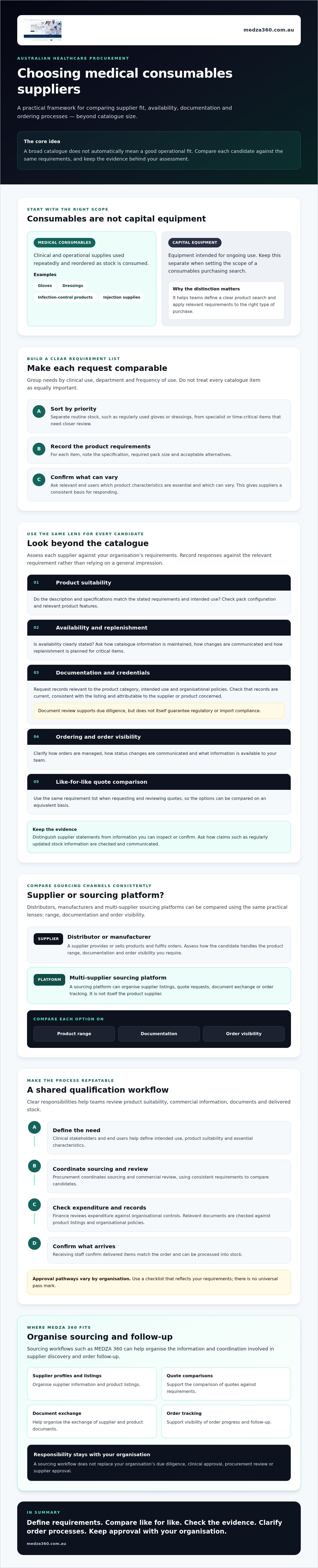
Medical consumables are clinical and operational supplies used repeatedly and reordered as stock is consumed. Examples include gloves, dressings, infection-control products and injection supplies. They differ from capital equipment intended for ongoing use. A supplier provides or sells products and fulfils orders. A sourcing platform, by contrast, can organise supplier listings, quote requests, document exchange or order tracking, but isn’t itself the product supplier. For a broad overview of medical equipment, consider how consumables differ from durable devices when setting the scope of a purchasing search.
Range is only one measure of supplier fit. Buyers also need usable product specifications, clear availability information and defined replenishment arrangements. A relevant-looking listing may not specify pack size, product features or whether available stock can meet an organisation’s needs. Confirm these details before comparing options, and ask how the supplier will communicate changes to availability or order status.
Which consumables should buyers include in a supplier search?
Group requirements by clinical use, department and frequency of use. Separate routine stock, such as regularly used gloves or dressings, from specialist or time-critical items that need closer review. This helps teams set priorities without treating every catalogue item as equally important.
For each requirement, record the specification, required pack size and any acceptable alternatives. Ask relevant end users to confirm which characteristics are essential and which can vary. A consistent requirement list gives suppliers a clear basis for responding and helps procurement compare equivalent products.
Who is involved in institutional consumables procurement?
Procurement coordinates sourcing and commercial review. Clinical stakeholders define intended use and assess product suitability. Finance reviews expenditure against organisational controls, while receiving staff confirm that delivered items match the order and can be processed into stock. The approval pathway varies by organisation.
Involve end users when setting specifications, before requesting quotes. Institutional procurement is a governed business process, not consumer or retail shopping. Decisions need to account for operational requirements, internal approvals and repeat ordering, not just an individual’s product preference.
How to assess medical consumables suppliers beyond catalogue size
A large catalogue can make product discovery easier, but it doesn’t show whether a supplier can meet your operational requirements. Assess each candidate against the same criteria and keep the evidence behind your assessment. This makes differences clearer and gives reviewers a practical basis for follow-up.
Distinguish supplier statements from information you can inspect or confirm. If a supplier says stock information is updated regularly, ask how often listings are reviewed and how changes are communicated. Procurement teams can also consult the Association of Healthcare Supply & Procurement Officers for professional context on healthcare supply and procurement.
What product and availability information should buyers review?
Check that the product description matches the required specification and intended use. Confirm pack configuration, stated availability, substitution arrangements and how catalogue information is maintained. For critical items, ask how the supplier plans replenishment and will report a change in availability. Record each response against the relevant requirement rather than relying on a general impression.
How should buyers review supplier documents and credentials?
Request records relevant to the product category, intended use and your organisation’s policies. Check that they are current, consistent with the product listing and attributable to the supplier or product concerned. Where appropriate, confirm information through an authoritative source. Document review supports due diligence, but doesn’t itself guarantee regulatory or import compliance.
Use the same checklist for every candidate, with criteria that reflect your organisation’s requirements. There is no universal pass mark.
- Product fit: Do descriptions and specifications address the stated requirements?
- Availability evidence: Is stock information clear, and are update practices explained?
- Replenishment: Is there a documented approach for routine and critical items?
- Ordering: Are ordering steps, account requirements and quote details clear?
- Communication: Are contacts and processes for changes or queries identified?
- Delivery information: Are relevant delivery arrangements and order updates explained?
- Documents: Are requested records available, current and consistent with the listing?
For each criterion, record the supplier’s response, the evidence reviewed, any open question and the reviewer responsible. Label evidence as confirmed, incomplete or requiring follow-up instead of reducing the assessment to a single score. This keeps the rationale for the shortlist visible and makes outstanding checks easier to resolve.
A sourcing workflow can keep listings, quote comparisons and document exchanges together for review. MEDZA 360’s supplier sourcing tools support these activities. Buyers remain responsible for evaluating evidence and approving suppliers.
Compare medical consumables suppliers and sourcing channels consistently
Compare sourcing channels against the same purchasing requirements, not catalogue size alone. Direct distributors, manufacturers and multi-supplier sourcing platforms serve different roles. A distributor or manufacturer supplies products; a sourcing platform supports discovery and procurement workflows but doesn’t itself supply the consumables.
Use the comparison below to identify what each channel may show and what your team still needs to confirm. Details vary by supplier and platform, so treat these points as questions to ask, not assumed features.
| Channel | Range and stock information | Documentation | Ordering and order visibility |
|---|---|---|---|
| Direct distributor | Confirm product coverage, availability detail and how stock changes are reported. | Request relevant product and supplier records; check they match your requirements. | Clarify account and ordering steps, replenishment arrangements and available status updates. |
| Manufacturer | Check whether its offered range meets your item requirements and how availability is communicated. | Ask which supporting records are available for the products under review. | Confirm whether purchasing is direct or through a distribution arrangement, and how orders are followed up. |
| Multi-supplier sourcing platform | Review listings from participating suppliers; verify current availability with the relevant supplier. | Check what document exchange or review functions are available, then assess records yourself. | Assess quote-request and comparison workflows, and clarify what order tracking information is provided. |
When might a direct distributor or manufacturer suit the requirement?
A direct channel may suit an organisation with established product ranges, account arrangements or ordering processes. Confirm that the supplier can provide the required items and support replenishment needs. Direct sourcing doesn’t, by itself, establish availability or regulatory suitability. Buyers remain responsible for checking product fit and supporting evidence against internal requirements.
When can a multi-supplier sourcing platform support procurement?
A platform can bring together listings from multiple suppliers and help teams submit quote requests and compare responses against a shared specification. It can also organise supplier information, document exchange and order visibility where those functions are available. A platform doesn’t determine which supplier or product is suitable, and quote comparison doesn’t guarantee savings or a preferred outcome. Buyers retain responsibility for assessment and approval.
Keep quotation review focused on consistent, like-for-like details, including specification, pack configuration, availability and ordering terms. For a detailed process, use the article’s dedicated quotation comparison guide. Choose the channel that best fits your organisation’s purchasing controls, product requirements and capacity for follow-up. No single model is right for every need.
Build a repeatable medical consumables supplier qualification workflow
A documented qualification process gives every supplier the same review pathway and creates a record of how a purchasing decision was reached. It also clarifies who can approve products, suppliers and orders. Set out the process before requesting quotes, then apply it consistently to shortlisted medical consumables suppliers.
How should a buyer create and review a supplier shortlist?
Start with essential product requirements and operational expectations, including availability information, replenishment arrangements and order communication. Use consistent criteria to record evidence, gaps and follow-up questions. Involve clinical and procurement stakeholders early so product suitability and purchasing controls are assessed before approval.
Use a workflow such as this, adapting each stage to your organisation’s governance:
- 1. Define requirements. Procurement documents the items, specifications, pack configurations and service expectations. Clinical stakeholders confirm requirements for intended use.
- 2. Identify candidates. Build a shortlist from relevant supplier information and listings. Record why each candidate appears to meet the initial requirements.
- 3. Request and review information. Procurement gathers responses and compares them against the same criteria. The assigned document reviewer checks submitted records against product requirements and internal policy.
- 4. Obtain approvals. Clinical stakeholders assess product fit. Procurement completes its review, and finance or other authorised roles follow the organisation’s approval process.
- 5. Set up approved ordering. Confirm who may place orders, how exceptions are escalated and what receiving staff should check against each order.
How can teams maintain oversight after supplier onboarding?
Qualification continues after onboarding. Set review intervals through internal governance, taking account of product criticality and purchasing controls. Assign procurement to monitor supplier communications and order exceptions, while receiving staff record discrepancies. Clinical reviewers should assess proposed substitutions before they’re accepted for use.
Define review triggers as well as scheduled reviews. A change in listed availability, a repeated order issue, a proposed substitution or a material change in supplier information may call for follow-up under your procedures. Record the issue, decision, responsible person and resolution in the approved workflow. Track order status using information available to your team, and escalate delays or exceptions through established channels.
MEDZA 360 is a B2B sourcing platform, not a consumables supplier. Its supplier profiles, listings, document exchange and order-tracking functions can support procurement record-keeping. Your organisation remains responsible for assessment and approval. Organise supplier sourcing and order follow-up through the platform.
Use MEDZA 360 to organise medical consumables sourcing and follow-up
MEDZA 360 is an Australia-based B2B sourcing platform that connects healthcare procurement teams with manufacturers and distributors. It isn’t a medical consumables supplier, manufacturer or product seller. Its role is to support sourcing workflows by bringing supplier profiles and product listings together with quote requests, document exchange and order tracking.
This gives procurement teams a structured place to review information from potential medical consumables suppliers. A profile or listing is a starting point, not an approval decision. Assess the relevant supplier, product and records against your organisation’s requirements, then follow established internal approval processes.
Which sourcing tasks can MEDZA 360 support?
Use supplier profiles and product listings to support discovery across participating manufacturers and distributors. Buyers can submit quote requests and compare responses through the platform, helping keep sourcing information organised for review. Document exchange and review workflows can support the handling of supplier information, while order tracking provides a place to follow orders. Confirm what information and updates are available for the workflow you plan to use.
These functions support coordination; they don’t determine product suitability or guarantee availability, regulatory compliance or import compliance. Procurement staff remain responsible for evaluating supplier responses and records. Clinical stakeholders retain responsibility for product suitability under the organisation’s processes, and designated reviewers should conduct any required regulatory assessment.
What should buyers confirm before adopting a sourcing platform?
Before using a platform, check its access requirements, the supplier information available to your team and whether its quote, document and order workflows fit internal procedures. Clarify who can submit requests, review supplier information, approve products and follow up orders. Confirm how records will be retained or referenced in your organisation’s purchasing process.
Set clear boundaries between platform support and organisational accountability. A digital workflow may help teams keep sourcing activity together, but it doesn’t replace clinical review, procurement controls, document checks or regulatory assessment. Supplier profile information or verification must not be treated as a substitute for your own due diligence.
If your procurement team is considering a more organised sourcing workflow, review MEDZA 360 access options and check whether the available capabilities align with your requirements before adopting the platform.
Make supplier selection a repeatable procurement process
Effective sourcing depends on more than catalogue breadth. Define product and replenishment requirements first, then assess medical consumables suppliers against consistent criteria for product fit, availability, documentation and ordering. A documented qualification workflow helps clinical, procurement, finance and receiving stakeholders understand their responsibilities and apply decisions consistently.
Compare sourcing channels according to your organisation’s needs. Direct suppliers and multi-supplier platforms serve different purposes, and neither removes the need to review product information, assess supplier evidence or follow internal approval processes.
MEDZA 360 is an Australia-based B2B sourcing platform connecting healthcare procurement teams with manufacturers and distributors. Its quote comparison, document exchange and order-tracking capabilities can support sourcing and follow-up workflows. The platform doesn’t sell consumables or guarantee regulatory or import compliance; due diligence remains with your organisation.
Review MEDZA 360 sourcing platform access to assess whether its available workflows fit your procurement requirements. With clear criteria and defined oversight, your team can make supplier decisions more consistently and keep sourcing activity organised.
Frequently Asked Questions
How do I choose a medical consumables supplier in Australia?
Start by documenting the products, specifications and replenishment arrangements your organisation requires. Compare medical consumables suppliers using the same criteria, including product information, availability visibility, ordering steps, communication and supporting documents. Involve clinical stakeholders in assessing product suitability and procurement staff in reviewing supplier and purchasing processes. Check supplier claims against evidence and internal requirements. Reassess the arrangement if products, organisational needs or supply arrangements change.
What should healthcare organisations check before approving a medical consumables supplier?
Review product suitability, specifications, supplier information, ordering arrangements and the records your organisation requires. Confirm that documents are current and relevant to the product category, and identify any gaps for follow-up. Assign responsibility for clinical assessment, procurement review and ongoing oversight before approving a supplier. A supplier profile or platform listing may support discovery, but it doesn’t replace your organisation’s due diligence or approval process.
Can a sourcing platform guarantee that a medical consumables supplier is compliant?
No. A sourcing platform can support supplier discovery, information exchange and procurement records, but it can’t guarantee regulatory or import compliance. Define the checks relevant to the product and your organisation, verify evidence through suitable sources, and document approval decisions. Before relying on a platform’s verification process, confirm what it covers and what evidence it provides. Your organisation remains responsible for assessing suppliers and products against applicable requirements.
How can procurement teams compare medical consumables suppliers fairly?
Apply the same documented criteria to every supplier. Compare product specifications, listed availability, ordering processes, delivery information, supporting documents and communication arrangements. Keep evidence and unresolved questions distinct from supplier claims so reviewers can see what has been confirmed and what needs follow-up. Assess quotations through your organisation’s procurement process using consistent requirements. A like-for-like comparison makes decisions easier to explain, without assuming that one supplier or sourcing channel suits every need.
What is the difference between a medical consumables supplier and a sourcing platform?
A supplier offers products for purchase, while a sourcing platform helps buyers discover supplier listings and manage procurement tasks. Depending on its features, a platform may support quote requests and comparison, document exchange or order tracking. MEDZA 360 is a B2B sourcing platform connecting healthcare procurement teams with manufacturers and distributors; it doesn’t sell medical consumables. Confirm which functions and verification processes are available, and retain responsibility for supplier approval and product assessment.
How can organisations manage recurring orders for medical consumables?
Maintain an approved product list, assign replenishment responsibilities and monitor stock or order information through your chosen process. Record substitutions, delays and supplier communications so exceptions can be reviewed and escalated. Set internal procedures for critical items, including who assesses proposed alternatives. Listings and order tracking may improve visibility where available, but confirm what updates are provided and how frequently. Maintain appropriate contingency arrangements under your organisation’s governance.
Do Australian medical consumables suppliers need to meet the same requirements?
No. Requirements can vary according to product category, intended use and applicable Australian regulatory settings. Don’t assume every consumable has identical obligations. Identify the requirements relevant to each product, then check current authoritative guidance, including Therapeutic Goods Administration information where relevant. Review supplier and product evidence against your organisation’s process, and seek qualified regulatory advice where needed. Platform listings or supplier verification don’t replace those checks.